
Dragons
Creating a Dragon
The dragon can be treated as both a race and a class, with some inherent abilities and others that they develop as they grow older and more experienced.
Dragon/Dragonkeeper Bond and Leveling
Dragons all have a humanoid bonded to them at birth. Typically, their humanoid entourage selects potential riders who gather around a clutch of eggs. Then, the dragon chooses the correct rider to bond with, sometimes before it even emerges from its egg.
Dragons gain new class features in tandem with riders, leveling up each time their rider does. If a dragon bonds with somebody after their rider dies, it typically happens in a short period of time. A rider and dragon must both have the same number of dragon/dragonkeeper class levels. In some rare cases, a dragon might wait for their chosen humanoid to have the same number of levels as them. An unbonded dragon will continue to level up as they gain experience.
Dragon Bond Variant
You may choose to let a PC play a dragon. In such a case, the rider will level up in tandem with them instead. They may also play a dragon whose rider has died and who has not yet bonded again.
| The Dragon | |||
| Level | Proficiency Bonus | Features | Damage Die |
| 1st | +2 | Hatchling, Racial Traits, Mental Bond, Unarmored Defense, Dragon Color, Bite | 1d4 |
| 2nd | +2 | Fearless | 1d4 |
| 3rd | +2 | Fire breath | 1d4 |
| 4th | +2 | Ability Score Improvement | 1d4 |
| 5th | +3 | Claw | 1d4 |
| 6th | +3 | Wyrmling | 1d4 |
| 7th | +3 | Specialty | 1d6 |
| 8th | +3 | Ability Score Improvement | 1d6 |
| 9th | +4 | Tail | 1d6 |
| 10th | +4 | Specialty Feature | 1d8 |
| 11th | +4 | Dragonling | 1d8 |
| 12th | +4 | Ability Score Improvement | 1d8 |
| 13th | +5 | Claw improvement | 1d10 |
| 14th | +5 | Planar Travel, Specialty Feature | 1d10 |
| 15th | +5 | Young Dragon | 1d10 |
| 16th | +5 | Ability Score Improvement | 1d10 |
| 17th | +6 | Claw Improvement | 1d12 |
| 18th | +6 | Grown Dragon, Improved Bite | 1d12 |
| 19th | +6 | Ability Score Improvement | 1d12 |
| 20th | +6 | Adult Dragon | 2d8 |
Non-Adventuring Dragons
If a dragon does not gain enough experience to increase their statistics by at least one step each year (eg. Hatchling to wyrmling or grown dragon to adult dragon), they will automatically jump to the next level that will increase their statistics on their next birthday. For example, a wyrmling that stops adventuring at level 7 will automatically level up to level 9 on their next birthday. This will also cause the rider to level up, but the rider must choose dragonkeeper levels for these level ups.
Quick Build
To create a dragon, first choose the color and specialty you want unless the color is randomly determined. Generally, black and orange dragons do not adventure. If you are making a brute, maximize Strength. An expert flyer will want higher Dexterity. A planar guide will need high Wisdom, and Masters of Self will want high Constitution. Your second highest ability should be Constitution or Strength, unless you intend to travel the planes often, in which case you will need high Wisdom. Low Wisdom is acceptable for dragons that do not use their Planar Travel ability often.
Dragon Traits at Birth (Racial Traits)
You have a variety of natural abilities, gifted to you by the Mypa that created your race long ago.
Ability Score Increase Your ability score increase depends on the color dragon you are. You cannot begin with more than 20 in any ability score. See the table below for details.
| Color | Strength | Dexterity | Constitution | Intelligence | Wisdom | Charisma |
| Black | +10 | -3 | +10 | +5 | +3 | – |
| Orange | +8 | -2 | +6 | +6 | +2 | – |
| White | +5 | +8 | +6 | +2 | -3 | +2 |
| Red | +3 | +6 | +4 | +2 | +5 | -2 |
| Purple | +3 | +7 | +4 | +0 | +2 | +2 |
Age Dragons age quickly and live long lives. They are born as hatchlings and reach adulthood in about 5 years. Dragons with strong bonds to riders may grow to adulthood much more quickly. If they are bonded to adventurers, they should age as described in the dragon class table. Regardless of their age, dragons are born intelligent, with the ability to communicate, reason, and potentially fend for themselves, though some are naïve at a young age. Most dragons not bonded to adventurers progress through several year-long stages of life, starting as hatchlings for the first year, then becoming wyrmlings at age 1, then dragonlings, young dragons, grown dragons, and finally adult dragons at age 5.
Alignment Alignment is based on subrace, though no dragons are evil-aligned.
Size Hatchlings are small at birth and grow over time. Regardless of their color, hatchlings are small, wyrmlings are medium, dragonlings are large, and young dragons are huge. Grown and adult dragons are gargantuan, but some are bigger than others, depending on the subrace of dragon.
Use the table below to determine your size as a grown or adult dragon.
| Black | Orange | White | Red | Purple | |
| Grown | 25 x 25 ft | 25 ft x 25 ft | 25 ft x 25 ft | 25 ft x 25 ft | 25 ft x 25 ft |
| Adult | 45 x 45 ft | 40 ft x 40 ft0 | 35 ft x 35 ft | 30 ft x 30 ft | 30 ft x 30 ft |
With permission from the GM, any adult dragon’s size may vary by one size. For gargantuan creatures, increasing their combat space by 5 feet on either side is the equivalent of increasing their size by 1. For example, a dragon that should be gargantuan (35 ft by 35ft) as an adult could become gargantuan (30ft by 30ft) or gargantuan (40ft by 40ft). Size changes should generally be determined randomly. For instance, the DM may have you roll a d20, and you may grow one size larger if you roll an 18 or higher and one size smaller if you roll a 3 or lower.
Speed Speed varies by subrace and increases with age. See the table below for details.
| Color | Black | Orange | White | Red | Purple |
| Hatchling | 25 ft., swim 30 ft., climb 30 ft. | 25 ft., swim 30 ft. | 30 ft., swim 30 ft. | 25 ft., swim 30 ft., climb 30 ft. | 25 ft., swim 30 ft. |
| Wyrmling | 30 ft., swim 30 ft., climb 30 ft. | 30 ft., swim 30 ft. | 35 ft., swim 35 ft. | 30 ft., swim 30 ft., climb 30 ft. | 30 ft., swim 30 ft. |
| Dragonling | 35 ft., climb 35 ft., fly 70 ft. | 35 ft., fly 70 ft. | 40 ft., swim 40 ft., fly 80 ft. | 35 ft., climb 35 ft., fly 70 ft. | 35 ft., swim 35 ft., fly 70 ft. |
| Young Dragon | 40 ft., fly 90 ft., climb 45 ft. | 40 ft., fly 80 ft. | 45 ft., fly 90 ft., swim 45 ft. | 40 ft., fly 90 ft., climb 40 ft. | 40 ft., fly 80 ft., swim 40 ft. |
| Grown Dragon | 45 ft., fly 90 ft., hover, climb 45 ft. | 40 ft., fly 80 ft., hover | 50 ft., fly 100 ft., swim 50 ft. | 40 ft., fly 90 ft., hover, climb 40 ft. | 45 ft., fly 90 ft., swim 45 ft. |
| Adult Dragon | 45 ft., fly 90 ft., hover, climb 45 ft. | 40 ft., fly 80 ft., hover, burrow 20 ft. | 50 ft., fly 100 ft., swim 50 ft., burrow 20 ft. | 40 ft., fly 90 ft., hover, climb 40 ft. | 45 ft., fly 90 ft., swim 45 ft. |
Truesight The dragon has truesight for 60 feet.
Scales You are resistant to slashing damage.
Damage Immunity You are immune to fire damage.
Antimagic Bubble If targeted by a magical effect, or in the area of effect of a magical effect, the dragon casts the antimagic field spell as a reaction, blocking the initial damage. The dragon has advantage on saving throws to maintain concentration in this spell and the spell is not affected by the antimagic field. This ability does not protect from greater or lesser artifacts, or from effects they produce.
The dragon casts this spell once between long rests.
Languages The dragon has telepathy for 60 feet. It understands Dragonrider, the language of the dragonfolk, and can read and understand Old Iphmotj, the ancient lost language of the mypa.
Subraces
Dragon society is organized by color, as each subrace of dragon is a different color and has different preferences, rank, and abilities. Your color is determined at birth by your GM or rolled randomly. The GM may choose to let you pick a color, as well. PCs should generally be bonded to purple, white, or red dragons because orange and black dragons are generally not allowed to adventure.
Black Dragon
As a black dragon, you are of the highest rank in dragon society. As the largest and most powerful dragon, you are a force to be reckoned with, but rarely spend time on the battlefield. Due to territorial nature, you avoid other black dragons, and will not allow another black dragon to exist on the Material Plane with you. This means that you must be protected at all costs since no other dragon can lay a black or orange egg.
This power may influence your behavior as you are the most important creature in your territory, wielding ultimate influence over all other dragons and dragonkeepers. That said, many black dragons fight against the restrictions other dragons will impose in an attempt to protect them. They are almost never adventurers, and adventurers who bond with this color dragon will likely become frustrated by restrictions or be forced to retire.
Your alignment is Chaotic Good.
All black dragons are female and have female riders. As an adult dragon, you are able to lay eggs as described in the Ferellan Bestiary and Nature Guide
Planar Travel At 14th level when you gain the Planar Travel feature, you also gain the ability to speak to your ancestors through that planar connection. You contact a black dragon that has passed on, using the same check and modifiers that apply to your Planar Travel ability. For the purposes of this check, you are considered to have met your mother while in the egg. This contact can be used to ask one question, which your ancestor does not have to answer, truthfully or otherwise. In most instances, your ancestor will want to help you and have no reason to lie. The response should only be one of two sentences, and does not need to be an answer to your question.
Orange Dragon
As an orange dragon, you may become mates with the black dragon, and become the patriarch of dragons on the Material Plane. Since you are not as rare as the black dragon, you will likely take on the everyday responsibilities of the black dragon after mating, particularly any that might put them in danger. Different dragons react differently to this privilege, as some develop a sense of entitlement while others have a deep and profound sense of duty. They are almost never adventurers, and adventurers who bond with this color dragon will likely find that their duties to the dragons make it difficult to adventure.
Your alignment is Lawful Good.
Orange dragons are male and only accept male riders.
Commanding Presence Orange dragons are born leaders. When you command somebody to do something, they will typically listen to you unless they are hostile or it is against their best interests. You can get a friendly or indifferent creature to obey simple commands for one turn without a check.
White Dragon
As a white dragon, you are a wild card. You likely feel no obligation to follow the rules set forth by draconic society, though your love and devotion to dragonkind remains the same. You can attain the same rank as orange dragons, or even become the patriarch alongside a black dragon, but most of your kind choose not to.
Most likely, you consider yourself a commoner, even amongst humans, and you may even leave draconic society to travel with a small group of other dragons or dragonkeepers. Despite this, other dragons will treat you as if you rank higher than purple and red dragons.
Your alignment is Chaotic Good.
White dragons are almost always male and will accept riders of any gender. Female white dragons are sterile.
Agility Despite your size, you are more agile than most creatures. You are able to perform deft aerial maneuvers to avoid attackers. When you are hit with an attack while you are flying, you may use evasive maneuvers as a reaction to add your proficiency bonus to your AC.
Red Dragon
As a red dragon, you are nurturing and intuitive. Otherwise, your personality is affected by your interests, much as human personalities are. You are essentially a commoner, with high rank amongst dragonkeepers but low rank among other dragons. This gives you freedom to adventure and do as you please most of the time, but you are required to show deference to higher-ranking dragons, including all white, orange, and black dragons.
Your alignment is Lawful Good.
Red dragons are female and will accept any gender rider.
Maternal Intuition Traditionally, red dragons collect candidates for dragon hatchings. This role comes from their own maternal capabilities and allowed them to evolve an uncanny ability to sense potential riders in the area. When you reach adulthood at 20th level, you can spend one minute focusing your mind on finding intuitive people in the area. Each creature within 60 feet must make a Intelligence saving throw at the end of that minute. Use the same DC you would use for your fire breath. On a failed save, their Wisdom score is revealed to you and your rider. You can share false information with your rider if you so choose. On a successful save, the individuals become aware of your presence, but do not know your exact location unless you are withing sight and unhidden.
You also have the ability to add your proficiency bonus to checks made to tell if a creature is able to speak and understand languages, and to tell whether the creature is intelligent enough to have a conversation.
Purple Dragon
As a purple dragon, you are one of the common folk of the dragoncliffs. You are a footsoldier at times, whether you are spreading news or fighting a war. This means that you are more in touch with what goes on in the world, and makes you a wonderful adventurer. While you are of lower rank than the white, orange, and black dragons, you are revered by dragonkeepers and many other humanoids.
Your alignment is Lawful Good.
Purple dragons are male and will accept any gender rider.
Unobtrusive Presence Purple dragons pride themselves on fitting in anywhere, both physically and socially. As a hatchling and wyrmling, you are often overlooked when spending time in human establishments as long as you behave as if you belong. This only occurs in settlements that are neutral towards dragons. Once you reach large size, your physical abilities allow you to perch on ledges that are only half your size without any restriction or disadvantage.
Evolving Traits (Class Traits)
As a dragon, you gain the following class traits. You gain levels when your rider gains levels rather than gaining your own experience. You count as a party member when the GM is dividing up experience, nonetheless. When you are born, you bond with a rider, gaining all traits for their dragonkeeper level and any previous levels. For example, if the rider is at 2nd level when you bond, you instantly gain all 1st and 2nd level features.
Hit Points
Hit Dice: 1d12
Hit Points at 1st level: 12 + your Constitution modifier
Hit Points at Higher Levels: 1d12 (or 7) + your Constitution modifier per dragon level after 1st
Proficiencies
Armor: any armor your rider is proficient in
Weapons: none
Tools: none
Saving Throws: see table below to determine the saving throws for your color
| Black | Orange | White | Red | Purple |
| Wisdom, Constitution, Strength, Intelligence | Charisma, Constitution, Strength, Wisdom | Charisma, Constitution, Strength, Dexterity | Dexterity, Constitution, Strength, Intelligence | Intelligence, Constitution, Strength, Dexterity |
Skills: see table below to determine the skills for your color dragon
| Black | Orange | White | Red | Purple |
| Perception, Stealth, Animal Handling | Perception, Intimidation, Athletics | Perception, Acrobatics, Persuasion | Perception, Insight, Intimidation | Perception, Stealth, Intimidation |
Equipment
You have no starting equipment.
Hatchling
You are a hatchling. Other dragons will refer to you by this title, and your size and speed will be affected by this. See the size and speed sections of the dragon race for details. At this age, only tiny creatures can ride you, and you may only carry one tiny creature at a time.
Mental Bond
Starting at 1st level or at the time of bonding, dragons and their bonded have a mental bond that is similar to the bond created between a charmed creature and the person that charms it. Thus, they cannot be charmed by any outside source, magical or otherwise. You and your rider share your thoughts and emotions through this bond, and the range of your telepathy extends to 10 miles when speaking to your bondmate. This telepathy is severed if you are in a different plane of existence from your rider.
You may use this bond to understand any language your rider knows.
Unarmored Defense
While you are not wearing any armor, your Armor Class equals 10 + your Dexterity modifier + your Proficiency bonus. A harness, saddle and saddlebags, or similar items do not count as armor.
Bite
You are unable to use conventional weapons, relying instead on the power of your body to defeat enemies. You have a bite attack that deals 2 damage die worth of piercing damage. See the dragon class table for the damage die for your level. You are proficient in this attack and use Strength for your attack and damage bonuses.
When you reach gargantuan size at level 18 , this attack has a reach of 10 ft., plus 5 additional feet for every 10 feet of space your dragon takes up in combat. For example, a gargantuan (30 ft. x 30 ft.) dragon would have a reach of 15 ft. for this attack.
Multiclassing
You or your bondmate may choose to multiclass after you become bonded and your bondmate gains their bonded abilities at 3rd level. If you or your bondmate chooses to multiclass, then the other must also multiclass. You may not have a different number of levels in the dragon class than your bondmate does in the dragonkeeper class. NPC dragons or riders will automatically choose to multiclass if their bondmate wants to.
Fearless
At 2nd level, you have learned that you are one of the scariest creatures out there. You now have advantage on saving throws against fear.
Fire Breath
At 3rd level, you have learned to effectively spark fire within yourself to use as a weapon. When making this attack, you exhale fire in a cone. Each creature in the area must make a Dexterity saving throw, taking fire damage on a successful save, or half as much damage on a successful one. The DC for the Dexterity saving throw is 10 + your Constitution modifier. Cone size is determined by the table below.
Black, red, and purple dragons deal 10 damage die worth of damage, orange dragons deal 15 die worth of damage, and white dragons deal 13 damage die worth of damage. The dragon class table will determine what damage die you use.
After using this ability, roll a d6. On a 5 or 6, you are able to use the ability again. Otherwise, you must wait until you complete a long rest before using the ability again.
| Black | Orange | White | Red | Purple | |
| Hatchling | 10 ft. | 15 ft. | 10 ft. | 15 ft. | 10 ft. |
| Wyrmling | 15 ft. | 30 ft. | 15 ft. | 20 ft. | 15 ft. |
| Dragonling | 30 ft. | 60 ft. | 30 ft. | 30 ft. | 30 ft. |
| Young Dragon | 60 ft. | 90 ft. | 60 ft. | 60 ft. | 60 ft. |
| Grown Dragon | 100 ft. | 120 ft. | 90 ft. | 90 ft. | 90 ft. |
| Adult Dragon | 180 ft. | 160 ft. | 120 ft. | 120 ft. | 120 ft. |
Ability Score Increase
When you reach 4th level, and again at 8th, 12th, 16th, and 19th level, your Constitution and Strength increase by 2 and your Intelligence, Charisma, and Wisdom each increase by 1.
Claw
At 5th level, you learn to use your claws and your teeth simultaneously and can use a claw attack in addition to your bite attack during the same action. Your claw attack deals 2 damage die worth of slashing damage. You are proficient in this attack and use Strength for your attack and damage bonuses. Your Strength modifier can only be added to the first attack on any turn.
At level 13, you can attack once with your bite and twice with your claw attack during the same action.
When you reach level 17, this attack has a reach of 10 ft.
Wyrmling
At 6th level, you are a wyrmling, having survived the first year of life or gained an equivalent amount of experience while adventuring. Other dragons will refer to you by this title, and your size and speed will be affected by this. See the size and speed sections of the dragon race for details. Your fire breath cone size will also be affected. See the Fire Breath class ability for details. You are now big enough for one small creature or two tiny creatures to ride.
Specialty
While not every dragon has a specialty, most adventuring dragons will focus on a particular interest, developing their specialty in tandem with their rider or independently. Your specialty grants you features at 7th level and again at 10th, and 14th levels.
Tail
At 9th level, you have found a way to extend your reach using your tail to attack. You can now attack with your tail, reaching targets as far away as the combat space you use in feet. For example, if you are large-sized, you can reach targets 10 feet away and if you are huge-sized, you can reach targets 15 feet away. Your tail attack deals 3 damage die worth of bludgeoning damage. You are proficient in this attack and use Strength for your attack and damage bonuses. This attack takes a full action.
Dragonling
At 11th level, you become a dragonling, having gained two years of life experience or an equivalent amount of adventuring experience. Other dragons will refer to you as dragonling, and your size and speed will be affected by this. See the size and speed sections of the dragon race for details. Your fire breath cone size will also be affected. See the Fire Breath class ability for details. This is also the age at which you can carry either a small or a medium passenger, or an equivalent number of tiny creatures.
Planar Travel
At 14th level, you begin to reach your potential as a planar guardian. You gain the following feature:
As an action, the dragon enters the Ethereal Plane and exits in a plane of choice. The plane must be adjacent to the Ethereal Plane. The dragon must make a Wisdom check to connect to the plane and location through the ethereal plane. They are proficient in this check and add the following modifiers based on how familiar they are with the location. Use the following table to determine what modifiers to add to the check:
| Knowledge | Check Modifier |
| Secondhand (they have heard of the location) | -2 |
| Firsthand (they have been to the location) | +1 |
| Familiar (they know the location well) | +5 |
| Connection | Check Modifier |
| Image of the location (which may come from the rider’s mind) | +2 |
| Possess an object that has been to the location | +4 |
| Possess an object that originates from the location | +8 |
If the dragon gets a 1 on the check, they enter the ethereal plane but do not reach their destination. Riders can get off the dragon and explore as if the ethereal plane had been their destination. On a 2-9, the dragon fails to transition to the ethereal plane and remains in place, wasting one use of the ability. On a 10-14, the dragon transitions to a similar or adjacent place. On a 15 or higher, the dragon successfully reaches its destination.
Any creatures or objects that are riding the dragon or carried by it are also transported. Creatures riding the dragon cannot get off the dragon while traveling through the ethereal plane except as specified above. If they are removed from physical contact with the dragon while in the ethereal plane, they must perform a DC 15 Dexterity saving throw or fall off the dragon into the ethereal plane. Objects and creatures that cannot move automatically fail this saving throw. The dragon can use this ability twice between long rests.
Young Dragon
Having reached 15th level, you become a young dragon. You have lived for a full three years or gained an equivalent amount of adventuring experience. Other dragons will refer to you as dragon, treating you like a teenager or young adult, and your size and speed will be affected by this. See the size and speed sections of the dragon race for details. Your fire breath cone size will also be affected. See the Fire Breath class ability for details. You can carry a large creature now, provided their anatomy allows them to ride you. Otherwise, you may carry two medium or small creatures, or an equivalent number of tiny creatures.
Grown Dragon
At 18th level, you are considered grown, though your final growth spurt is ahead of you. You have gained most of your adult abilities at four years old or with equivalent adventuring experience and have only to gain a bit more life experience and skills. Other dragons will refer to you as a dragon, treating you as a young adult, and your size and speed will be affected by this change. See the size and speed sections of the dragon race for details. Your fire breath cone size will also be affected. See the Fire Breath class ability for details. At this age and size, you can carry a creature one size smaller than you or an equivalent number of smaller creatures.
Adult Dragon
At 20th level, you are at the pinnacle of your abilities, whether you have reach adulthood at the age of five like most dragons or used adventuring experience and your close bond to age rapidly. Other dragons will refer to you as a dragon, seeking your wisdom, and your size and speed will be affected by this change. See the size and speed sections of the dragon race for details. Your fire breath cone size will also be affected. See the Fire Breath class ability for details. At this age and size, you can carry a creature one size smaller than you or an equivalent number of smaller creatures.
Specialty
All dragons have different personalities that lead them to focus their energy on different pursuits. Some focus in utilizing their brute strength in combat while others learn to control their body in a more refined style. Still more study the planes and the inherent connection they hold with them.
Brute
Dragons are enormous creatures with a lot of weight and power. You have chosen to take advantage of this power and become a force of nature on the battlefield, doing things that are far beyond the scope of a normal dragon.
Run Towards Danger At level 7, you fight with unyielding ferocity. When you successfully resist an effect that would cause fear, you can use your reaction to move up to half your speed towards the creature and make a single bite or claw attack.
Improved Tail Attack At level 10, you have learned to shift your weight through the motions of your attacks. When you use your tail attack, you can add your proficiency bonus to the damage roll.
Force of Nature By level 14, you are like a cannonball, jumping into the fray and taking out anything in your path. When you hit with a claw or tail attack, you can choose to knock the target prone. This occurs directly after the attack that hits, even if it is part of a multi-part attack. For example, you can bite a creature, claw it and knock it prone, then claw it again after it is prone.
Expert Flyer
You have chosen to refine your flying abilities to become an expert at ranged combat, staying out of enemy reach while dealing precise blows.
Tiny Allies At level 7, you have learned to use tools to your advantage. You can forgo one or more of your claw attacks, instead using that attack to throw a tiny object or creature from your back at a target. This deals two damage die of damage on a hit and uses Dexterity for the attack and damage rolls. If you throw a creature, it can then take its turn immediately after being thrown, forgoing its next turn in initiative.
Trip By the time you reach level 10, you have refined your muscle control and can now trip opponents with your tail. When you hit with your tail attack, you may use a bonus action to attempt to trip the creature you hit. The creature must make a Dexterity saving throw equal to 8 + your Dexterity modifier + your proficiency bonus. On a failure, they are tripped and fall prone.
Aerial Expert At level 14, you have learned to perform aerial maneuvers to outsmart your enemies. While in the air, you can reroll any attack rolls in which the number on the die shows 8 or less. While on the ground, you can reroll any attack rolls in which the number on the die shows 5 or less.
Planar Guide
As a creature of intellect, you focus on your inherent connection with the planes of existence, learning secrets of the multiverse and how to explore and protect it safely and effectively.
Planar Studies At level 7, you have studied creatures that originate in other planes of existence or use energy from those planes as their predominant life force, such as elementals, fiends, and undead. Choose one of the following types of creatures: aberrations, celestials, elementals, fey, fiends, or undead.
You have advantage on Wisdom (Survival) checks to track the chosen creature type, as well as on Intelligence checks to recall information about them. When you gain this feature, you also learn one language of choice that is spoken by those creatures, if they speak one at all.
At the start of combat with such a creature, you learn one random fact from their character sheet. For example, you may learn their Intelligence modifier, walking speed, of something far more useful such as one of their immunities.
Planar Jump At level 10, you learn an early form of the Planar Travel ability. As a bonus action, you and anybody riding you can teleport 30 feet to a point you can see within range. This ability can be used a number of times equal to your Intelligence modifier and all uses are restored after a long rest.
Tour Guide At level 14 when you gain the Planar Travel ability, you have studied locations in various planes diligently. You may add your proficiency bonus to any checks made to perform planar travel successfully.
Master of Self
You have mastered your inner spark and learned to channel the energy of your creation into different effects.
Breath Control At level 7, you can choose which element you exhale when you use your fire breath. Pick one of the following damage types: acid, cold, lightning, thunder. You can use that damage type in place of fire damage when using your fire breath ability. Each damage type also gains an effect specified in the following table:
| Acid | The target must make a Constitution saving throw against your fire breath save DC. They take an extra damage die worth of acid damage at the start of their next turn on a failure. |
| Cold | The target must make a Constitution saving throw against your fire breath save DC. Their speed is reduce by half on a failure. |
| Fire | The target must make a Constitution saving throw against your fire breath save DC. They take an extra damage die worth of fire damage at the start of their next turn on a failure. |
| Lightning | The target must make a Constitution saving throw against your fire breath save DC. They take an extra damage die worth of lightning damage at the start of their next turn on a failure. |
| Thunder | The target must make a Strength saving throw against your fire breath save DC. They are pushed back 10 feet on a failure. |
Power Within At level 10, you have delved deeply into the mysteries of your own creation, learning to create effects other than exhaling elements. Pick one of the following damage types: force, necrotic, poison, radiant. You can now use that damage type in place of fire damage for your fire breath ability. Each damage type also gains an effect specified in the following table:
| Force | The target must make a Strength saving throw against your fire breath save DC. They are pushed back 10 feet on a failure. |
| Necrotic | The target must make a Constitution saving throw against your fire breath save DC. Their hit point maximum is reduced by half of one damage die, rounded down, on a failure. |
| Poison | The target must make a Constitution saving throw against your fire breath save DC. They are poisoned on a failure. |
| Radiant | The target must make a Constitution saving throw against your fire breath save DC. On a failure, they cannot add their ability score modifier to their next damage roll. |
Resistance of the Mypa At level 14, you have mastered the inner workings of your body and become one with your status as an Artifact. Your antimagic bubble now protects you from lesser Artifacts.
Dragonkeepers
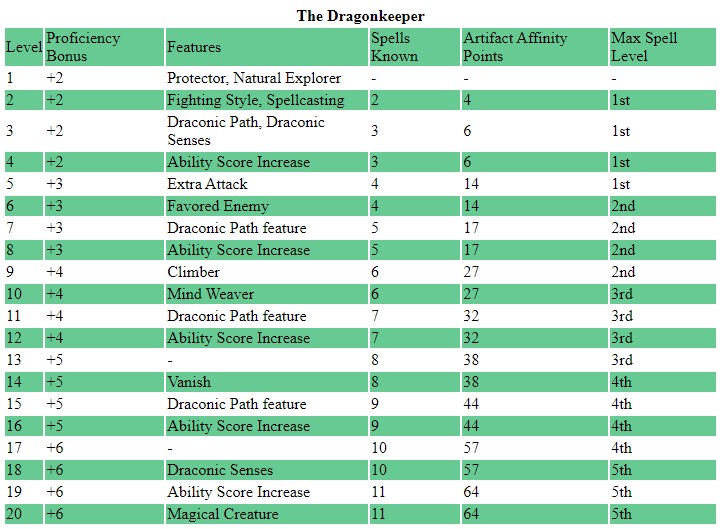
Dragonkeepers’ devotion to dragons grants them the ability to tap into that well of Artifact energy and channel it into their own unique form of magic. Dragonkeeper magic is a manifestation of their desire to protect, understand, and improve the lives of dragons.
Even though their magic is connected to dragons, a dragonkeeper doesn’t need to be near a dragon to access their power.
Healers, Walkers, and Riders
Not all dragonkeepers ride dragons or have a mental bond with them, though some do. In fact, most dragonkeepers are simply people who are devoted to the creatures, often because they grew up amongst the dragonfolk. They support dragons and draconic culture in many ways, preserving history and culture, as well as life and limb. Some devote themselves to protection, both physical and intellectual, traveling around the globe to spread truths and counter lies that the bards of Ferella often tell. Others devote themselves to healing and supporting the dragons and other dragonkeepers, while a select few form an impenetrable mental bond with their own dragon.
Dragon Agency and the Dragonkeeper Faction
Many people believe that dragons are very intelligent pets, but those who live amongst them know that dragons are their own agents, doing as they please rather than obeying the command of somebody they are bonded to. A dragon would be as likely to obey the humanoid they bond to as the humanoid would be to obey them.
While many dragonfolk live at the hidden dragoncliffs for their entire lives, many others are born with the wanderlust that comes with being a descendant of a dragonkeeper. Those folks choose to become dragonkeepers and undergo the training associated with the Dragonkeeper faction. Some choose to adventure in the name of the Dragonkeepers, while others choose to be free agents after receiving their initial training.
Creating a Dragonkeeper
Dragonkeepers all choose this life for a reason. Some grew up around dragons and were drawn to their magnetic energy while others saw them from afar and believed these creatures were their destiny. Still others were recruited during scarce times when dragonkeepers had difficulty finding potential riders. Some were even taken as a child, willingly or otherwise, to be trained in becoming a dragonrider.
Why did your character choose this life? Were they raised at the foot of a dragoncliff, or were their parents dragonriders? Perhaps they were a foundling or were taken from home at a young age for the privilege of serving the dragons.
You will have to decide how your character views their duties. Are they a sacred trust to maintain dragons as a species? A service offered to a graceful and inherently good creature? Perhaps your character is merely devoted to their own dragon with no grander notions. Others still may focus on the service they bring to the world by fighting for justice and peace against interplanar threats.
Quick Build
You can make a dragonkeeper quickly by following these suggestions. First, make Dexterity your highest ability score, followed by Wisdom. Second, choose the soldier background.
Class Features
As a dragonkeeper, you gain the following class features.
Hit Points
Hit Dice: 1d10 per dragonkeeper level
Hit Points at 1st Level: 10 + your Constitution modifier
Hit Points at Higher Levels: 1d10 (or 6) + your Constitution modifier per dragonkeeper level after 1st
Proficiencies
Armor: light armor, medium armor, shields
Weapons: simple weapons, martial weapons
Saving Throws: Charisma, Dexterity
Skills: Choose three from Acrobatics, Draconics, Insight, Intimidation, Medicine, Perception, Performance, Stealth, and Survival
Equipment
You start with the following equipment, in addition to the equipment gained by your background:
(a) a rapier or (b) a simple melee weapon
(a) leather armor or (b) scale mail
(a) a diplomat’s pack or (b) an explorer’s pack
(a) a longbow and a quiver with 20 arrows or (b) a hand crossbow and a case with 20 bolts
If you start with a gold allowance instead of class equipment, dragonkeepers should start with 5d4 x 10 gp.
Protector
Beginning at 1st level, you have significant experience studying, protecting, and talking to dragons.
You have advantage on Wisdom (Perception) checks used to track dragons (any creature with the dragon type), as well as on Intelligence checks to recall information about them.
You also speak, read, and write Dragonrider, the language of the Dragonfolk.
Natural Explorer
You have traveled far and wide, spreading information and acting as a scout. Often, you are the first person to tread a piece of ground and you need to be skilled at navigating it. You are particularly familiar with or have avidly studied one type of environment and are adept at traveling and surviving in such regions. Choose one type of favored terrain: arctic, coast, desert, forest, grassland, mountain, or swamp. When you choose a terrain type, you specialize in that terrain in all planes of existence. When you make an Intelligence or Wisdom check related to your favored terrain, your proficiency bonus is doubled if you are using a skill that you’re proficient in.
While traveling for an hour or more in your favored terrain, you gain the following benefits:
- Difficult terrain doesn’t slow your group’s travel.
- Your group can’t become lost except by magical means. While traveling with a dragon, your group can’t become lost by any means, magical or otherwise.
- Even when you are engaged in another activity while traveling (such as foraging, navigating, or tracking), you remain alert to danger.
- If you are traveling alone, you can move stealthily at a normal pace. If you have a dragon with you, they are able to move stealthily at your normal pace.
- When you forage, you find twice as much food as you normally would.
- While tracking other creatures, you also learn their exact number, their sizes, and how long ago they passed through the area.
You choose additional favored terrain types at 6th and 14th level.
Fighting Style
At 2nd level, you adopt a particular style of fighting as your specialty, using that ability to protect yourself and others while challenging those who defame your kind. Choose one of the following options. You can’t take a Fighting Style option more than once, even if you later get to choose again.
Archery
You gain a +2 bonus to attack rolls you make with ranged weapons.
Protective
When a creature you can see attacks an ally that is within 5 feet of you, you gain advantage on attacks against that creature until its next turn or until another ally within 5 feet of you takes damage.
Dueling
When you are wielding a melee weapon in one hand and no other weapons, you gain a +2 bonus to damage rolls with that weapon.
Defense
While you are wearing armor, you gain a +1 bonus to AC.
Spellcasting
By the time you reach 2nd level, you have spent enough time around dragons that you have learned to tie into the essence of magical Artifacts (such as dragons) to cast spells. Even when dragons are far away, you can tie into the nearest Artifact and use it to cast your spells.
Artifact Affinity Points
The dragonkeeper table shows how many Artifact affinity points you have to cast your spells of 1st level and higher. It also shows the highest-level spell you can cast with those points. To cast one of these spells, you must expend a number of Artifact affinity points equal to the amount shown in the Artifact affinity table. You regain all expended affinity points when you finish a long rest.
For example, if you know the 1st-level spell animal friendship and have four Artifact affinity points, you can cast it at 1st level with two points or at 2nd level with three points. When upcasting, use the number of artifact affinity points required for the level you wish to cast at.
| Spell Level | Artifact affinity points used |
| 1st | 2 |
| 2nd | 3 |
| 3rd | 5 |
| 4th | 6 |
| 5th | 7 |
Spells Known
You know two 1st-level spells of your choice from the dragonkeeper spell list.
The Spells Known column of the Dragonkeeper table shows when you learn more dragonkeeper spells of your choice. Each of these spells must be below the maximum spell level for your level, as shown in the Dragonkeeper Table. For instance, when you reach 5th level in this class, you can learn one new spell of 1st or 2nd level.
Additionally, when you gain a level in this class, you can choose one of the dragonkeeper spells you know and replace it with another spell from the dragonkeeper spell list, which must also be of a level at or below the maximum spell level for your level.
Spellcasting Ability
Wisdom is your spellcasting ability for your dragonkeeper spells, since your magic draws on your attunement with natural Artifacts. You use your Wisdom whenever a spell refers to your spellcasting ability. In addition, you use your Wisdom modifier when setting the saving throw DC for a dragonkeeper spell you cast and when making an attack roll with one.
Spell save DC = 8 + your proficiency bonus + your Wisdom modifier
Spell attack modifier = your proficiency bonus + your Wisdom modifier
Draconic Path
At 3rd level, you choose the path of the Walker, Healer, or Bonded. You may only choose the Bonded path if you are bonded to a dragon. Each path grants you features at 3rd level and again at 7th, 11th, and 15th level.
Draconic Senses
Beginning at 3rd level, you can use your action and expend 2 Artifact affinity points to focus your awareness on the region around you. For 1 minute, you can sense whether the following types of creatures are present within 1 mile of you (or within up to 6 miles if you are in your favored terrain): aberrations, celestials, elementals, fey, fiends, and undead. You can sense whether dragons are present within 6 miles of you regardless of what terrain you are in. This feature doesn’t reveal the creatures’ location or number.
Ability Score Improvement
When you reach 4th level, and again at 8th, 12th, 16th, and 19th level, you can increase one ability score of your choice by 2, or you can increase two ability scores of your choice by 1. As normal, you can’t increase an ability score above 20 using this feature.
Extra Attack
Beginning at 5th level, you can attack twice, instead of once, whenever you take the attack action on your turn.
Favored Enemy
At 6th level, you have significant experience tracking, hunting, and even negotiating with the various enemies of dragonkind.
Choose a type of favored enemy: abberations, beasts, celestials, constructs, elementals, fey, fiends, giants, monstrosities, oozes, plants, or undead. Alternatively, you can select two races of humanoid (such as orcs or gnolls), two classes (such as bard or druid), or two factions (such as the Dragon College or Theives’ Guild) as favored enemies.
You have advantage on Wisdom (Survival) checks to track your favored enemies, as well as on Intelligence checks to recall information about them.
When you gain this feature, you also learn one language of choice that is spoken by your favored enemies, if they speak one at all.
You choose one additional favored enemy, as well as an associated language, at 10th level. As you gain levels, your choices should reflect the types of enemies you have encountered on your adventures.
Climber
You have spent significant time navigating dragoncliffs, scouting in dangerous regions, and riding upon dragons. Starting at 9th level, climbing costs you no extra movement, and you have advantage on saving throws to avoid falling from a height.
In addition, when falling from a height, you take damage as if you had fallen half as far as you did.
Mind Weaver
You have learned to imitate dragons’ mental strength and abilities to manipulate people and situations favorably. Starting at 10th level, you can spend 1 minute to weave your thoughts into another creature’s mind, telling the creature a story. The story must be told in such a way that it sounds like something that could have happened. You must share a language with the creature or have telepathy for this feature to have an effect.
The target must make a Wisdom saving throw. On a failed save, it believes the story for the next 8 hours, coming up with any justifications or explanations needed to make your story sound plausible. When they receive new information that contradicts your story, they can make another Wisdom saving throw. On a failed save, they reject the new information as false. On a successful save, they stop believing your story.
You can also tell them about something that will happen instead of something that has already happened. For example, you can say that if a particular person arrives at a party, it is because she is there to steal a necklace from the party host. If the person doesn’t arrive within 8 hours, the target will never worry about the theft or expect it to happen.
If you or your bonded dragon damage the target or tell the target something contrary to your story, the target will no longer believe the original story, and you cannot use this feature on them again for 24 hours.
Vanish
Starting at 14th level, you can use the hide action as a bonus action on your turn. Also, you can’t be tracked by nonmagical means, unless you choose to leave a trail.
Draconic Senses
At 18th level, you gain draconic senses that help you sense creatures you normally couldn’t. If a creature is using magic to hide from you, you are able to see it if you would be able to see it without magical aid. For instance, if a creature casts Pass without Trace and tries to hide from you, you would compare your passive Perception to the number they rolled without adding the bonus from Pass without Trace.
You are also aware of the location of any invisible creature within 30 feet of you, provided the creature isn’t hidden from you and you aren’t blinded.
Magical Creature
At level 20, your extensive experience with dragons has granted you resistance to damage from magical attacks. You can now use your reaction to subtract your Wisdom modifier from the attack roll or the damage roll of a magical attack made against you. You must choose to use this feature before you know the results of the roll you are using it on. You can announce your intention to use the ability before an attack is made by telling the Game Master that you will use the ability the next time you are hit with an attack.
Draconic Path
Path of the Bonded
This path can only be chosen by a character bonded to a dragon. You can choose to multiclass rather than gaining a third dragonkeeper level until you are bonded to a dragon. If you bond to a dragon, you must choose this path as soon as possible, and cannot multiclass again until after you have chosen this path.
Mental Bond
You are bound with a dragon and share your thoughts and emotions with it as well. The dragon operates on its own initiative and is controlled by the GM. This connection allows you to communicate telepathically with your dragon within a 10-mile radius. This communication is severed if you are in a different plane of existence from your dragon.
In addition, this mental bond gives you immunity to being charmed.
Dragon Statistics
Your dragon uses the hatchling statistics. Their size and statistics change as you gain levels as a dragonkeeper. Use the Dragon class and race to create your dragon and increase their level.
Draconic Might
When you bond with your dragon at 3rd level, your bond allows you to channel magical energy into various effects. You may choose from one of the following abilities:
Fear the Beast. When you first move to a space within 30 feet of an enemy, you can use an action to attempt to frighten them. Each enemy that can see or hear you within 30 feet of you must make a Wisdom saving throw with a DC equal to your spell save DC. If the creature fails its saving throw, it is frightened for 1 minute or until it takes damage. A creature that succeeds on its saving throw is immune to this effect for 24 hours.
Dragon’s Strength. As an action, you can imbue yourself with draconic strength. For one minute, you add your Wisdom modifier to all attack rolls (with a minimum bonus of +1). Your attacks also become magical for the duration.
You can end this effect on your turn without using an action. If you fall unconscious, this effect ends.
You must complete a short rest to use your Draconic Might ability again.
Bonded Spells
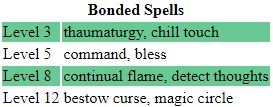
When you reach level 3, 5, 8, and 12 in the dragonkeeper class, you gain access to the spells for your level in the Rider Spells table. These spells are added to your spell list, and they count as dragonkeeper spells, even if they are not on the dragonkeeper spell list. You must prepare them as usual. You spend Artifact affinity points to cast them as usual.
Dragonsight
At 7th level, you gain truesight for 15 feet. At 15th level, this increases to 30 feet.
Draconic Caster
Starting at 11th level, you are immune to dragons’ antimagic bubble ability. When you cast a spell that would normally be affected by a dragon’s antimagic bubble, the spell is cast as normal. Any effects left behind by your spells, such as a glyph of warding, will not be affected by a dragon’s antimagic bubble ability.
Dragon Rider
At 15th level, you are able to ride your dragon well enough to fight with them. You as a player can now control your dragon’s actions. If your dragon does something obviously and completely contrary to their alignment, they may take 1d4 psychic damage, as determined by your Game Master. For example, a good dragon that kills an innocent child may take 1d4 psychic damage.
You may also choose one of the following abilities:
Aura of Protection. Pick up to three creatures of your choice within 30 feet. Whenever a target makes an attack roll or a saving throw against one of your chosen creatures, the target can roll a d4 and add the number rolled to the attack roll or saving throw. On your turn, you can change who the aura protects. You can use this feature a number of times equal to 1 + your Wisdom modifier. When you finish a long rest, you regain all expended uses.
Divine Senses. Strong good or evil register in your senses like a strong smell or taste. You are able to innately cast the detect evil and good spell. You can use this feature a number of times equal to 1 + your Wisdom modifier without expending any spell slots. When you finish a long rest, you regain all expended uses.
Aerial Retreat. You can cast the jump spell on yourself or somebody else as a bonus action. As an action, you can cast it on up to two creatures of choice, including yourself. You can use this feature a number of times equal to 1 + your Wisdom modifier without expending any spell slots. When you finish a long rest, you regain all expended uses.
Path of the Walker
This is the path that allows one to support dragons in a versatile manner. When you walk this path, you are the lone soldier and herald of dragonkind, defending dragons and their allies both verbally and physically. When a dragon or dragonkeeper finds themselves stranded, you are the one who shows up in their time of need.
Little Dragon
At 3rd level, you meet a pseudodragon companion who forms a mental bond with you. While bonded, you can sense what it senses within 1 mile. It can communicate emotions to you but cannot speak. Your bond is strong enough that it will not abandon you, but it may stop helping you if you are cruel to it. This companion is not a familiar, but a separately acting companion with its own turn in initiative.
Add your proficiency bonus to the pseudodragon’s attack rolls and damage rolls and to any saving throws or skills it is proficient in. Its hit point maximum equals four times your dragonkeeper level and it has a number of d4 hit die equal to your dragonkeeper level. Like any creature, it can spend Hit Dice during short rests to regain hit points. If it dies, you can only find another pseudodragon companion by exploring the rocky cliffsides in which these elusive creatures dwell.
While traveling through your favored terrain with only your bonded pseudodragon, you can move stealthily at a normal pace and the pseudodragon can use your stealth bonus if it is higher than the dragon’s.
When you first bond with your pseudodragon, it will not fight for you unless you are unconscious. At level 7, it will begin to fight in combat with you, using its own turn in initiative.
Walker Spells
When you reach level 3, 5, 8, and 12 in the dragonkeeper class, you gain access to the spells for your level in the Walker Spells table. These spells are added to your spell list, and they count as dragonkeeper spells, even if they are not on the dragonkeeper spell list. You must prepare them as usual. You spend Artifact affinity points to cast them as usual.

Last Line of Defense
Starting at 7th level, if an ally within 30 feet of you or your pseudodragon takes damage that reduces them to 0 hit points, you can use your reaction to absorb 1d8 points of damage. You can only use this feature if you have at least 9 hit points. Any resistances your ally has apply to this absorption; however, your own resistances do not apply.
Multiattack
At 11th level, you gain one of the following features of your choice.
Volley. You can use your action to make a ranged attack against any number of creatures within 10 feet of a point you choose within your weapon’s range. You must have ammunition for each target, as normal, and you make a separate attack roll for each target.
Whirlwind Attack. You can use your action to make a melee attack against any number of creatures within 5 feet of you, with a separate attack roll for each target.
Distraction. You can use your action to distract any number of creatures within 5 feet of you. Each creature of your choice within 5 feet of you must make a Wisdom saving throw against your spell save DC. If a creature fails its saving throw, it cannot attack any creature other than you until its next turn.
Telepathic Caster
At 15th level, you can cast any touch spell through your pseudodragon, as long as the pseudodragon is within 30 feet of you and is willing.
Path of the Healer
Dragons and their riders are revered by the common folk of Ferella. When one is injured or killed, it is a tragedy. Some dragonkeepers began to specialize in getting in and out of combat quickly so that they could stay alive and heal critically injured creatures. Dragonkeepers that walk the path of the healer focus on honing their natural agility and speed, as well as their ability to move through combat situations and provide basic healing without hindrance.
Nimble Action
At 3rd level when you choose this path, you have learned to evade combatants to tend to the wounded on a battle field. You can take a bonus action on each of your turns in combat. This feature can only be used to take the dash, disengage, or help action.
Healer Spells
When you reach level 3, 5, 8, and 12 in the dragonkeeper class, you gain access to the spells for your level in the Healer Spells table. These spells are added to your spell list, and they count as dragonkeeper spells, even if they are not on the dragonkeeper spell list. You must prepare them as usual. You spend Artifact affinity points to cast them as usual.

Battle Healer
At 7th level, you gain one of the following features of your choice.
Steel Will. You have advantage on saving throw against being frightened.
Sneaky. You can now use your Nimble Action feature to take the Use an Object action or stabilize a creature.
Medic. You now have a +2 bonus to any checks made to stabilize a creature. Creatures you stabilize with a Natural 20 now wake up with 2 hit points.
Fast Reflexes
At 11th level, you gain one of the following features of your choice.
Determined. When a creature within 5 feet of you hits or misses you with an opportunity attack or attempts to grapple you, you can use your reaction to attack that creature immediately afterwards, provided that you can see the creature.
Fast Step. You can drag a willing creature a distance up to your base movement speed without using any extra movement. You can use the dash action during the same turn that you use this feature, but you cannot drag the creature a total distance that is further than your base speed. While dragging the creature, you behave as if you had used the dodge action.
In and Out. When you cast a healing spell that has a casting time of 1 action, you can spend 1 Artifact affinity point to change the casting time to 1 bonus action for this casting.
Avoidance
At 15th level, you gain one of the following features of your choice.
Evasion. When you are subjected to an effect, such as a red dragon’s fiery breath or a lightning bolt spell, that allows you to make a Dexterity saving throw to take only half damage, you instead take no damage if you succeed on the saving throw, and only half damage if you fail.
Uncanny Dodge. When an attacker that you can see hits you with an attack, you can use your reaction to halve the attack’s damage against you.Stand Against the Tide. When a hostile creature misses you with a melee attack, you can use your reaction to force that creature to repeat the same attack against another creature (other than itself) of your choice.
Dragonkeeper Spell List
| 1st Level Bane Create or Destroy Water Cure Wounds Detect Magic Detect Poison and Disease Divine Favor Fog Cloud Goodberry Identify Inflict Wounds Jump Longstrider Shield of Faith | 2nd Level Aid Animal Messenger Augury Barkskin Darkvision Flaming Sphere Lesser Restoration Locate Object Misty Step Prayer of Healing Protection from Poison Silence Spiritual Weapon Warding Bond |
| 3rd Level Beacon of Hope Blink Conjure Animals Create Food and Water Dispel Magic Fly Glyph of Warding Remove Curse Sending Spirit Guardians Tiny Hut Water Walk | 4th Level Banishment Death Ward Guardian of Faith Secret Chest Wall of Fire 5th Level Commune Flame Strike Hallow Planar Binding |
 Moontouched Dragon